



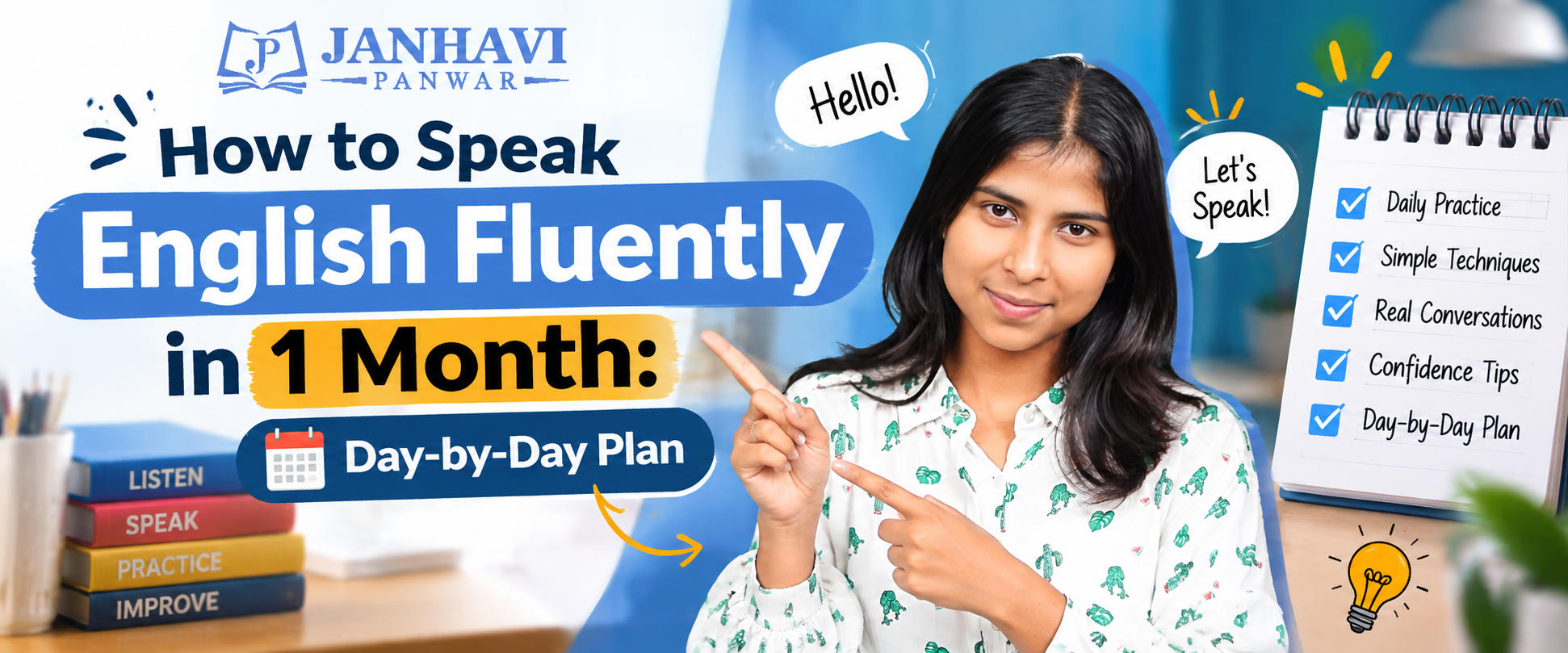
How to Speak English Fluently in 1 Month: Day-by-Day Plan
How to Speak English Fluently in 1 Month: Day-by-Day Plan
Every day, thousands of students search for one thing: "How can I speak English fluently in 1 month?" If you are one of them, you are in the right place. Most learners do not fail because they are weak in English. They fail because they have no clear plan. They study random grammar, watch endless videos, and still freeze the moment they have to speak.
In this guide, I will give you a simple 30-day plan built around one idea: speaking improves only when you speak. Follow it honestly for one month and you will notice a real change in your confidence, your vocabulary and your voice.
Can You Really Speak English Fluently in 1 Month?Let me be honest with you. Nobody becomes a perfect English speaker in 30 days. But you can absolutely become a confident, comfortable speaker who can hold everyday conversations without long pauses or fear.
Fluency does not mean speaking like a native or never making mistakes. It means expressing your thoughts smoothly and clearly. With focused daily practice, one month is enough to break the hesitation, build a base of useful words and start thinking in English. Your starting level matters, of course. Beginners will see a big jump in basic conversation, while intermediate learners will see a jump in speed and accuracy.
Four Rules Before You StartPractice speaking daily. Thirty minutes every day beats three hours once a week. Consistency builds the speaking muscle.
Accept mistakes. Every fluent speaker you admire made thousands of mistakes first. Mistakes are proof that you are learning.
Learn phrases, not single words. Instead of memorising "book", learn "I would like to book a table." Phrases help you speak faster.
Track your progress. Record a one-minute video of yourself on Day 1. You will compare it with Day 30 and be amazed.
Week 1: Build Your Foundation (Days 1 to 7)The first week is about removing fear and setting up your daily habit.
Day 1: Record and Reflect. Speak for one minute about yourself in English and record it. Do not judge it. This is your starting point.
Day 2: Learn 10 Everyday Phrases. Choose phrases for greetings, requests and small talk, such as "How is your day going?" Use each in a sentence out loud.
Day 3: Master Self-Introduction. Prepare a 60-second introduction covering your name, city, work or studies and hobbies. Practise it until it feels natural.
Day 4: Start Shadowing. Pick a short English video, listen to one sentence, pause and repeat it exactly, copying the tone and speed.
Day 5: Learn 10 New Words with Sentences. Write one sentence for each word about your own life. Personal sentences stick in memory.
Day 6: Talk to Yourself. Describe what you are doing right now in English. "I am making tea. I am adding sugar." It feels silly, and it works.
Day 7: Review and Rest. Revise the week's phrases and listen to your Day 1 recording again.
Week 2: Build Vocabulary and Sentence Speed (Days 8 to 14)Now that you have a habit, the goal is to speak faster and with more variety.
Day 8: Describe Your Daily Routine. Speak for two minutes about your day from morning to night, using time expressions like "after that" and "in the evening."
Day 9: Learn Connectors. Words like "because", "however", "for example" and "as a result" make your speech smooth and logical. Learn five and use them in short talks.
Day 10: Picture Description. Look at any photo and describe it for one minute. This trains you to find words quickly.
Day 11: Listen and Answer. Watch an English interview or podcast clip and answer the questions aloud as if they were asked to you.
Day 12: Learn 15 Words on One Topic. Choose food, travel, shopping or work, and learn related words together.
Day 13: First Real Conversation. Talk in English with a friend, family member or language partner for ten minutes. Perfection is not the aim, so keep going even if you make errors.
Day 14: Review and Record. Record another one-minute talk and compare it with Day 1.
Week 3: Fix Pronunciation and Think in English (Days 15 to 21)This week is about sounding clear and natural.
Day 15: Learn Sentence Stress. English is a stress-timed language. Practise stressing key words, as in "I NEED to FINISH this TODAY."
Day 16: Focus on Common Mispronounced Words. Choose ten words you often get wrong and check their pronunciation in a dictionary with audio.
Day 17: Practise Word Linking. Native speakers link words together, so "want to" becomes "wanna" in casual speech. Listen for this while shadowing.
Day 18: Think in English. For one full day, try to think in English rather than translating from Hindi. Start with small thoughts like "I am hungry" or "I need to leave."
Day 19: Storytelling. Tell a short story from your life in English, with a beginning, middle and end.
Day 20: Opinion Practice. Give your opinion on simple topics such as "Is social media good or bad?" Use "In my opinion" and "I believe that."
Day 21: Review and Record. Record a two-minute talk and check whether hesitation has reduced.
Week 4: Build Confidence and Real-Life Fluency (Days 22 to 30)The final week is about using English in real situations.
Day 22: Role-Play Real Situations. Practise ordering food, asking for directions and shopping. These are the situations you meet in real life.
Day 23: Practise Phone Conversations. Speaking without seeing the other person is harder. Practise short calls with a friend.
Day 24: Speak on Random Topics. Pick a topic at random and speak for two minutes without stopping. This trains your brain to react quickly.
Day 25: Interview Basics. Prepare answers to common questions like "Tell me about yourself" and "What are your strengths?"
Day 26: Group Discussion Practice. Join an online speaking group or practise with two or three friends.
Day 27: Watch and Summarise. Watch a five-minute video and summarise it in your own words.
Day 28: Correct Your Own Errors. Listen to your recordings and note the mistakes you repeat. Fix them one by one.
Day 29: Full Conversation Challenge. Have a 15-minute conversation in English without switching to Hindi.
Day 30: Final Recording. Record a two-minute talk and compare it with Day 1. Celebrate how far you have come.
Your Daily 60-Minute RoutineYou can follow this simple schedule every day. Spend 10 minutes learning new phrases or words, 15 minutes shadowing an English video, 20 minutes speaking practice with a partner or by yourself, 10 minutes listening to English content, and 5 minutes recording and reviewing your speech. Even if you have only 30 minutes, keep the speaking part and cut the rest.
Common Mistakes That Slow Down Your ProgressMany learners spend months on grammar rules before speaking a single sentence. Grammar matters, but it is learned best through speaking. Another mistake is translating word for word from Hindi, which creates slow and unnatural sentences. Others avoid speaking because they fear judgment, and the fear only grows with silence. Finally, many learners keep switching resources and never stay with one plan long enough to see results. Choose one method and stay consistent.
Frequently Asked QuestionsCan a beginner speak English fluently in 30 days?
A beginner can reach comfortable, basic conversation in a month with daily practice. Complete fluency takes longer, but the progress in one month is significant.
How many hours should I practise daily?
Aim for 45 to 60 minutes of focused practice. Quality and consistency matter more than long hours.
Do I need a teacher?
You can start on your own, but a trainer corrects your pronunciation and mistakes early, which saves months of wrong habits.
Should I learn British or American accent?
Choose the one you hear most or need for your goals. Clear pronunciation matters more than the accent type.
Speaking English fluently is not about talent. It is about a plan, daily practice and the courage to speak even when you are not perfect. Follow this 30-day plan and you will be surprised by how much you improve.
If you want expert guidance, structured lessons and personal feedback, explore the English courses by Janhavi Panwar, IDP Certified IELTS Trainer and Assistant Professor of English. Take the "Find Your Level" quiz on the website to discover which course fits you best, and start your journey today.